
Working Lands, Working Communities: Why Multiple Use Still Matters on America’s Federally Managed Lands
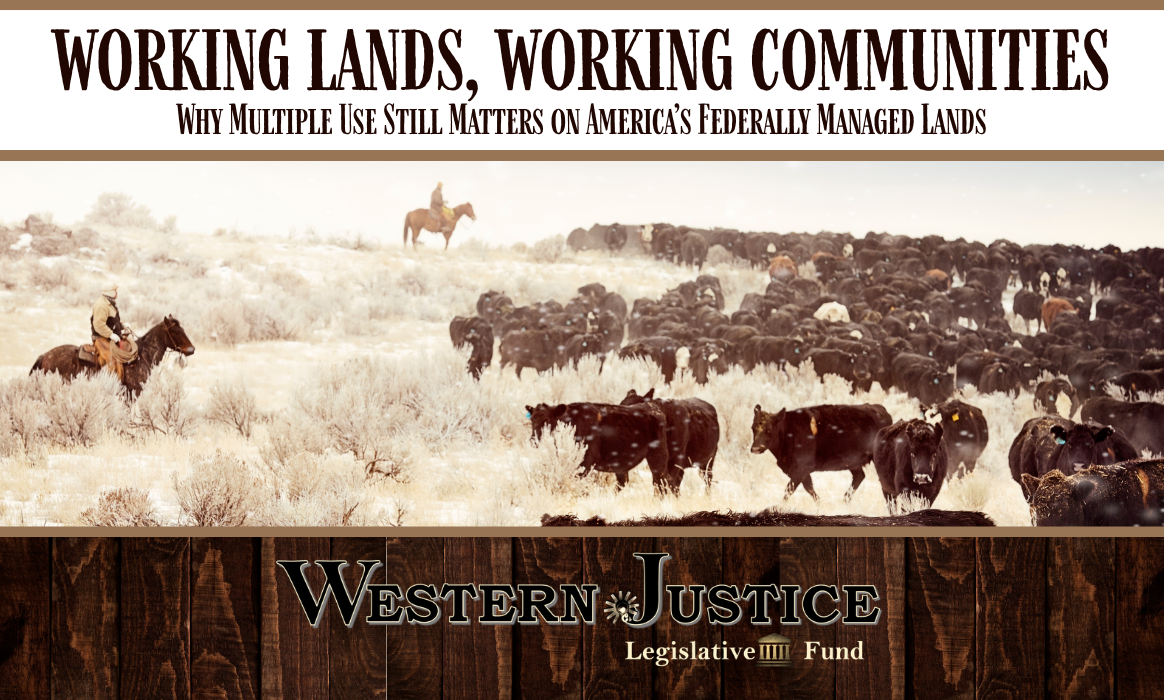
When people hear “public lands,” they might picture a national park overlook, a campground in Yosemite, or hiking trails. In the Interior West, the real picture is a county road, a haystack, a small town with schools and agriculture-based businesses, and surrounding ranches that rely on federal grazing allotments. The same map showing public lands can hold oil wells, mineral claims, timber sales, and power lines. Those uses are not a later overlay on wilderness. Congress established the legal principle that the public domain was supposed to be utilized for the greater good after the government stopped giving land away during the settling of the American West.
The American Farm Bureau Federation puts it simply: public lands belong to the nation, and Congress decided they would be managed for “multiple use” —care, enjoyment, use, and conservation together, not for a single preferred purpose.
The Laws Congress Used to Settle the West
After the Revolution, original states ceded western claims to the new national government. Purchases and treaties—Louisiana, Oregon, the Mexican Cession, Gadsden, Alaska—enlarged that public domain. Congress surveyed it on the rectangular grid and spent most of the nineteenth century transferring it: homesteads, railroad grants, mining claims, timber and desert-land entries. Roughly 1.2 billion acres left federal ownership.
The Homestead Act of May 20, 1862, was the best-known of the laws that tried to turn the public domain into private farms. President Lincoln signed it after Southern members of Congress, who had blocked earlier versions, left the Union. Beginning January 1, 1863, a head of household or person twenty-one or older who was a citizen—or had declared intent to become one—and who had not borne arms against the United States could enter 160 acres of surveyed, unappropriated public land. Live on it, cultivate it, and stay five years, and the government issued a patent for a small registration fee. A settler who wanted title sooner could commute the claim after six months by paying $1.25 an acre. Union veterans could count wartime service against the residency clock. By the time homestead laws were repealed in 1976, more than a million people had proved up, and on the order of 270 million acres had passed into private hands.
Congress kept enlarging the offer as the frontier moved onto drier ground. The Timber Culture Act (1873) and Desert Land Act (1877) tried to make tree-planting and irrigation count as “improvement.” The Enlarged Homestead Act of 1909 allowed 320 acres of non-irrigable land. The Stock-Raising Homestead Act of 1916 went to a full section—640 acres—on range classified as chiefly valuable for grazing, and it split the surface from the mineral estate, creating the “split estate” still common in the West. The five-year prove-up was cut to three years in 1912. Alaska was brought under homestead law in 1898. None of those amendments changed the basic bet: a family farm, earned by occupancy, would settle the country and put taxable private land on the county books.
How Remaining Lands Became “Public”
That bet worked where rainfall and soil matched the 160-acre model—the tallgrass and mixed-grass plains, river valleys, and pockets of irrigated ground. It failed across much of the arid Interior West. A quarter-section could not carry a herd through a Great Basin winter. Water holes and hay meadows were already claimed. Speculators, cattle companies, and dummy entrymen used the law as a way to fence water or lock up timber. Drought, grasshoppers, and isolation finished many honest claims. Entries peaked around 1910 and collapsed after the Dust Bowl. The Taylor Grazing Act of 1934 and Roosevelt’s withdrawals then closed most remaining public domain to new homesteads. What the 1862 Act did not patent stayed federal—and became the allotments, leases, and mineral claims that rural counties still live on.
The Role of Mining in the West
Mining was not a side show in that transfer. It was one of the main engines that put people on the ground. After the California Gold Rush, prospectors were already working public land under camp rules long before Washington wrote a statute. Congress first legalized lode claims in 1866 and placer claims in 1870. The General Mining Act of May 10, 1872, signed by President Grant, folded those laws into one system and declared that “all valuable mineral deposits in lands belonging to the United States” were “free and open to exploration and purchase.”
The Homestead Act and the 1872 Mining Law were twin disposal tools. One rewarded the plow; the other rewarded discovery. Together they explain why some Western ground is a deeded farm and some is still a federal section with a permit or a claim on it.
What remained in the West was not leftover by accident. Much of it was too dry, steep, or remote for a 160-acre farm. Settlement clustered in valleys and along water. The rest stayed federal.
Federal Land Policy and Management Act
The Taylor Grazing Act of 1934 ended the open-range free-for-all. It created grazing districts, permits, fees, and local advisory boards, and it effectively closed most remaining public domain to homesteading. The stated purposes were to stop overgrazing, put the range in order, and stabilize the livestock industry that already depended on it. In 1976 the Federal Land Policy and Management Act (FLPMA) made the next leap: remaining public lands would generally stay federal and be managed for multiple use and sustained yield. FLPMA ended the homestead chapter. It did not erase the map that chapter left behind.
FLPMA’s definition is not “every use on every acre,” and it is not “maximum dollar return.” It is the combination of uses that best meets present and future needs—recreation, range, timber, minerals, watershed, wildlife, and scenic, scientific, and historic values—without permanently impairing the land. That statute is BLM’s charter. It did not repeal the Taylor Act or the 1872 Mining Law. It put those older working-land systems inside a planning frame. That is why a modern BLM map still shows mining claims inside grazing allotments: two nineteenth-century disposal systems stacked on the same public domain.
What “productive use” Means in Statute
FLPMA made it clear: grazing, mining, logging, and energy are listed uses, not tolerated leftovers. Conservation values are in the statute too. Since FLPMA was enacted, the controversy has always been over whether “conservation” is one use among several or a veto over the others.
The 2024 Public Lands Rule was finalized by the BLM on May 9, 2024, as the Conservation and Landscape Health Rule (43 CFR parts 1600 and 6100). It took effect June 10, 2024. It treated conservation as a “use” alongside grazing, mining, and energy, created restoration and mitigation leases, expanded land-health standards beyond grazing, and tightened ACEC procedures.
BLM later issued a final rule fully rescinding that 2024 rule. The rescission was published in the Federal Register on May 12, 2026, and took effect June 11, 2026. It removed 43 CFR part 6100 and restored the pre-2024 ACEC framework in part 1600.
What remains in force is FLPMA itself—the 1976 multiple-use and sustained-yield statute—plus the older planning and grazing regulations the 2024 rule had amended. Conservation groups opposed the repeal; ranching and multiple-use groups supported it.
Grazing on Public Lands Feeds 9 Million People Every Year
Approximately 22,000 ranchers own roughly 120 million acres of private base property and hold permits on more than 250 million acres of BLM and Forest Service land. Nearly 40 percent of the western cattle herd and about half the national sheep herd spend part of the year on those allotments. Lose the federal piece and the private ranch often cannot carry the herd.
Public-lands forage supports around 2% of national beef production, and that point is sometimes used to imply the West could shrug off the allotments. However, that 2% amounts to 540 million pounds of beef each year. The average American consumes 56 pounds of beef per year, so the beef produced with grazing federally managed lands feeds 9.6 million people.
Farm Bureau economist Daniel Munch estimated more than $1 billion a year in livestock sales attributable to federal lands forage—about $893 million of that in cattle—with Idaho, New Mexico, and Wyoming at the top of the cattle list. There were about 17,911 active BLM permits and 10.8 million billed animal unit months in the data he cited. Ranchers pay on the order of $26 million a year in grazing fees.
University of Wyoming work funded through the cattle industry, covering Idaho, Oregon, and Wyoming, found that removing federal cattle grazing from operations that depend on it would cut those ranches’ cattle sales by about 60 percent, labor income by about 50 percent, and personal income per operation from roughly $34,000 to $12,000, with billions in downstream losses.
Federal Grazing Supports Economic Activity and More Jobs
Federal-grazing-dependent cattle ranches supported about $1.5 billion in total economic activity and more than 10,000 jobs. Removing that grazing was estimated at a $560 million annual hit and more than 4,000 jobs lost in those states—concentrated in rural counties with few substitute employers. In Owyhee County, Idaho, agriculture was 28 percent of employment.
BLM’s own FY 2024 economic report puts grazing on BLM land at $2.9 billion in output and 36,200 jobs. That is not the largest line on the BLM ledger. It is the line that keeps cow-calf country from hollowing out. Public Lands Council materials add that more than 60 percent of the western beef herd and more than half of western breeding ewes use public range at some point, and that those animals feed packing plants, truckers, feed dealers, veterinarians, and main-street stores far from the allotment.
Ranchers also argue grazing is a management tool, not only a commodity, citing fuels reduction, control of cheatgrass, maintenance of water developments that wildlife use, and the presence of people who notice a fire when it starts. Targeted grazing is now written into wildfire bills for a reason: untreated fine fuels on vacant allotments do not manage themselves.
Energy and Minerals are the Big Numbers—and the School Budgets
If grazing is the cultural backbone of many high-desert counties, oil, gas, coal, and hardrock mining are often the cash register.
BLM reports that activities it authorized in FY 2024 generated $245.4 billion in economic output and supported 884,000 jobs. Oil and gas alone accounted for $177 billion and 568,800 jobs. Coal added $9.1 billion and 30,300 jobs; nonenergy minerals $13.6 billion and 39,500 jobs; geothermal and other energy $7.8 billion and 20,000 jobs. Timber on BLM land was smaller—$1.4 billion and 5,700 jobs—but it still feeds mills in places where the mill is the town. Payments to states and counties from BLM-related activity were large enough to support 52,400 jobs in the agency’s accounting.
An API-backed analysis of FY 2022 onshore federal oil and gas found nearly 250,000 jobs, $19.4 billion in labor income, and $36.7 billion in GDP from that slice of the industry, with $35 billion in bonus, rent, and royalty disbursements over a decade—roughly half to the federal Treasury and half to states and localities. New Mexico, Wyoming, Colorado, Utah, and North Dakota took the heaviest employment shares. Those royalty streams pay for roads, schools, and hospitals in counties that cannot levy a property tax on the federal estate.
The National Mining Association, speaking for the industry as a whole (federal and nonfederal), reports on the order of 488,000 direct mining jobs, more than 800,000 indirect jobs, miner wages well above the national average, and tens of billions in tax payments. Federal land is where much of the West’s copper, gold, potash, phosphate, uranium, and construction aggregate sits. “Made in America” begins in a pit or a wellbore. That is not a slogan to mining towns; it is a payroll.
Rural Communities were Built Around the Permit, the Lease, and the Mill
A ranch in Nevada or a sheep outfit in Idaho is not a standalone factory. The Taylor Grazing Act tied the federal allotment to private base property. The deeded hay meadow and the BLM winter range are one operation. Pull the permit and the bank revalues the ranch, the next generation leaves, and the private ground is often carved into ranchettes that produce neither cattle nor wildlife habitat.
The same pattern holds for energy and timber counties. Federal land is not on the property-tax roll. Counties still provide search and rescue, roads, fire, and schools for the people who work that land and the visitors who drive across it. The National Association of Counties notes that about 62 percent of U.S. counties contain nontaxable federal land. Payments in Lieu of Taxes (about $733 million in FY 2026) and Secure Rural Schools payments exist because Congress recognized that gap. Mineral royalties and timber receipts are the other half of the bargain: production on federal land returns cash to the jurisdictions that host it. When harvests or leasing slow, SRS and county road budgets feel it immediately.
That is why wildfire, vacant allotments, NEPA delay, and monument expansions are often discussed at the same time as calf prices. A designation that looks like a line on a Washington map can unilaterally close schools and businesses in a county that is 60 percent federal land.
Multiple Use is a Working-lands Doctrine
FLPMA does not require the BLM to maximize extraction. It also does not authorize the agency to manage the public domain as if Taylor Grazing, the Mining Law, and mineral leasing were optional hobbies. The statute lists range, timber, and minerals beside recreation and scenery, and it tells the Secretary to consider relative values. It does not instruct the Secretary to pick a single winner.
The productive-use organizations make three claims that hold up under that text:
First, food and fiber from federal ranges are a western supply-chain fact. Lose the allotments, and you do not “move the cows east.” When grazing allotments are gone, the western herd shrinks, along with the towns attached to it.
Second, energy and minerals on federal land are an economic driver. They provide a measurable share of output, jobs, and public revenue. This is especially the case in New Mexico, Wyoming, Colorado, Utah, Nevada, and Alaska. Those dollars show up in state budgets and county services in a way recreation spending, however real, does not fully replace.
Third, rural capacity is not interchangeable. A displaced grazing permittee or a shuttered mill does not become a river-guide entrepreneur on cue. Even if it could, the river guide simply does not have the same economic contribution from employment to tax revenue to the community. Labor markets in counties like Owyhee, Carbon, or Catron counties are thin. The multiplier on a lost ranch job is local and durable.
Federally managed lands will always serve hikers, hunters, and wildlife. Those are in FLPMA too. The question being increasingly brought to the table is whether the traditional productive uses of federally managed lands, as Congress intended, remain part of the multiple-use concept. Congress said that federally managed public lands should “best meet the present and future needs of the American people”. Some groups are pushing changes to the definition of multiple use that would remove “public land” as a productive source of food, fiber, and energy and replace it with an intangible aesthetic ideal that serves only the few.


