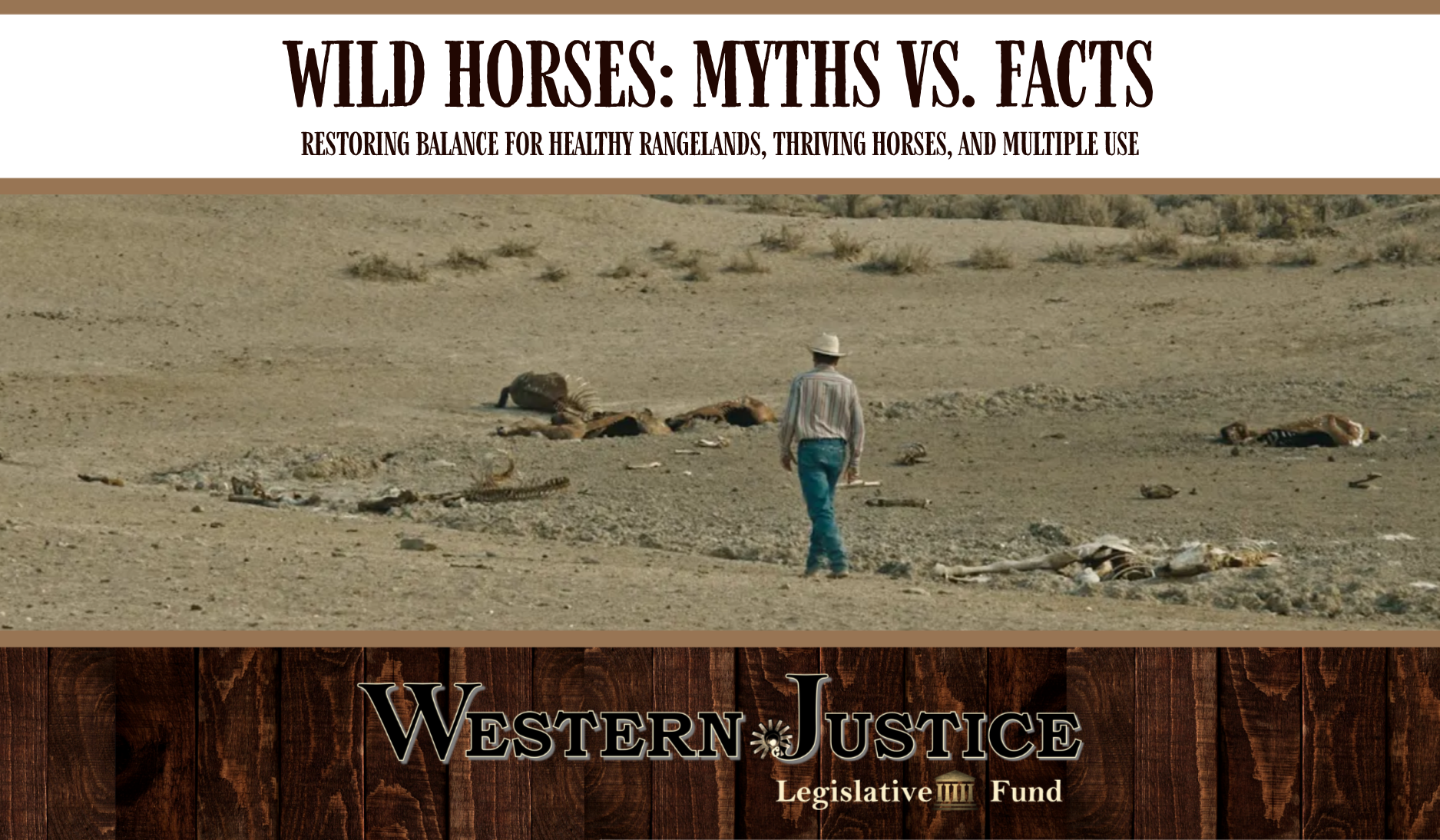
Wild Horses: Myths vs. Facts Restoring Balance for Healthy Rangelands, Thriving Horses, and Multiple Use
At Western Justice, our guiding principle is simple: Justice is Truth in Action. Nowhere is that more needed than in the debate over free-roaming horses on Western federally managed lands. Very few would deny the evocative appeal of horses running free, but unfortunately, emotional narratives and activist ideology have been allowed to override the law, science, and on-the-ground reality.
The result is populations far above appropriate management levels (AML), degraded rangelands, stressed water sources, displaced native wildlife, and horses themselves suffering from inadequate forage and water. Proactive management—including increased gathers and removals to bring herds down to AML—is not anti-horse. It is the only path that protects the health of the range, the horses, and the multiple uses Congress mandated for these lands.
Here are some of the persistent myths, and the facts that dismantle them.
Myth: Horses on American rangelands are wild, not feral. They are native to North America.
Fact: The free-roaming horses managed under the 1971 Wild Free-Roaming Horses and Burros Act are feral animals descended from domestic stock. Horses of the genus Equus evolved in North America millions of years ago, but the last native species went extinct here roughly 10,000–12,000 years ago at the end of the Pleistocene. Modern horses were reintroduced by Spanish explorers beginning in the late 15th and early 16th centuries. Escaped and released domestic horses formed the free-roaming herds we see today. They are not a “wild” species in the biological sense (the only truly wild horse remaining is Przewalski’s horse of Asia). Calling them “wild” is a legal and cultural designation under the 1971 Act, not a scientific one. Treating feral populations as if they were native wildlife ignores their domestic ancestry and the management realities that follow from it.
Myth: “Wild” horses are a distinct breed of horse.
Fact: There is no unique “wild horse” breed on Western rangelands. These animals are mixed descendants of domestic horses—primarily Spanish colonial stock brought to the Americas beginning in the late 15th and 16th centuries, later mixed with American ranch horses, cavalry mounts, draft breeds, and other domestic types that escaped or were released over the following centuries. They exhibit the full range of domestic horse colors, sizes, and types.
Genetic analyses confirm this domestic ancestry. Long-term microsatellite studies of Bureau of Land Management herds by researchers including E. Gus Cothran have repeatedly shown that most free-roaming populations have mixed-breed origins, with closest genetic similarity to common North American domestic breeds; only a minority of more isolated herds retain stronger Iberian/Spanish markers from the first modern domestic horses brought to the continent in the 1400s. Broader population-genomic and mitochondrial DNA research (including analyses of thousands of horses across dozens of herds and studies of early colonial remains) likewise demonstrates Iberian affinities overlaid by later British and other domestic influences, with no genetic evidence of a distinct pure “wild” lineage separate from domestic horses. Romanticizing them as a pure, ancient bloodline does not change the biological or legal facts, nor does it alter the ecological impacts of unmanaged population growth.
Myth: Appropriate Management Levels (AML) are arbitrary or anti-horse.
Fact: AML is the population range of wild horses and burros that can be maintained in a thriving natural ecological balance with other uses and the productive capacity of the habitat, as required by the 1971 Act. BLM establishes or adjusts AML through site-specific analysis under NEPA, using monitoring data on forage utilization, range condition and trend, climate, actual use, and other factors.
NEPA is the National Environmental Policy Act of 1969 (signed into law on January 1, 1970). It is the foundational U.S. environmental law that requires federal agencies to evaluate the potential environmental effects of their proposed major actions before making decisions. NEPA does not dictate what decision an agency must reach; instead, it mandates a process of analysis, disclosure, and public participation so that environmental consequences are considered alongside other factors.
The upper AML is the maximum number that maintains that balance without range deterioration; the lower limit is typically set to allow natural growth to the upper limit over several years without frequent gathers. Current on-range populations have routinely exceeded AML by two to three times or more (tens of thousands above the national upper limit of roughly 25,000–27,000). Ignoring AML does not help horses—it guarantees overpopulation, habitat damage, and eventual emergency gathers under far worse conditions.
Myth: Rangelands were “set aside” for wild horses.
Fact: Federal public lands were never set aside exclusively for horses. The 1971 Wild Free-Roaming Horses and Burros Act protects unbranded and unclaimed horses and burros “in the area where presently found” as of 1971 and requires that they be managed as an integral part of the natural system of the public lands “in keeping with the multiple-use management concept.” The Act explicitly limits management to those known territorial limits and does not authorize expansion into new areas.
Multiple-use principles are longstanding law. The Taylor Grazing Act of 1934 established orderly grazing districts and permits to prevent range destruction and provide for the orderly use and improvement of the public domain. The Multiple-Use Sustained-Yield Act (MUSYA) of 1960 directed management of national forests for a combination of uses including livestock grazing. The Federal Land Policy and Management Act of 1976 (FLPMA) codified multiple use and sustained yield for BLM lands, requiring management that best meets the present and future needs of the American people—including grazing, wildlife, recreation, minerals, energy, and other values. Ranchers hold long-established grazing rights under these statutes. Horses are just one rangeland component among many; elevating them above all other uses violates both the letter and spirit of the law.
Myth: Horses are healthy, so they shouldn’t be gathered.
Fact: Visible “health” in some animals does not mean the population is sustainable or that the range can support it. When populations exceed the land’s capacity for forage and water, horses travel farther, compete more intensely for resources, and ultimately decline in body condition—especially during drought or harsh winters. Ideally, proactive, preventative gathers keep horse numbers limited so horses, native wildlife, and livestock can all thrive without emergency interventions after animals are already in distress. The 1971 Act requires management to achieve a thriving natural ecological balance. Multiple-use mandates under Taylor Grazing, MUSYA, and FLPMA further require that horse numbers not monopolize limited resources. Leaving excess animals on the range until they starve or die of thirst is neither humane nor lawful management.
Myth: Helicopter roundups are inhumane.
Fact: Helicopter-assisted gathers are the most practical, efficient, and proven method for locating and moving horses across the vast, rugged landscapes of the West—often hundreds of thousands of acres with limited access. Alternatives to helicopters would be riders on motorized ground vehicles or horseback—options that are not only logistically impractical, but also much more dangerous for the people involved.
A University of Wyoming analysis of a decade of BLM gather data (2010–2019), published in the Journal of Equine Veterinary Science, found that acute (capture-related) mortality averaged fewer than one death per 300 horses gathered by helicopter—rates that did not differ significantly from bait/water trapping and were substantially lower than typical capture mortality for other large wildlife such as deer, elk, or caribou. Overall severe injury and death rates from gathers remain very low (typically well under 1 percent, often 0.1–0.3 percent in recent fiscal years).
Helicopters use pressure-and-release techniques; animals are not pushed to exhaustion (as is commonly claimed in fundraising efforts by wild horse activist groups), and on-site veterinary oversight plus the BLM’s Comprehensive Animal Welfare Program standards are required. Alternatives such as bait trapping can work for smaller or more accessible herds but cannot scale effectively to the numbers and distances involved when populations are hundreds of percent over AML, and the herd management area (HMA) spans hundreds of thousands of acres. The real cruelty is allowing overpopulation to continue until horses suffer from lack of water and forage.
Myth: Fertility control should be used instead of gathers and removals.
Fact: Fertility control tools such as PZP (porcine zona pellucida vaccine) can slow herd growth rates when applied to a high percentage of mares and maintained with repeated boosters. However, those methods do not remove excess animals already on the range. To bring a herd down to AML, gathers are still required. On the large, remote, and rugged HMAs typical of the West, most mares cannot be reliably darted from the ground; gathering is usually necessary to treat them. Because horses are long-lived and populations grow at 15–20 percent or more annually when uncontrolled, fertility control alone cannot solve overpopulation. Fertility control can be a useful complementary tool in some situations, but is not a substitute for the removals the law requires when excess animals are present.
Myth: Wild horses are shipped to slaughter.
Fact: It is and has been Bureau of Land Management policy not to sell or send wild horses or burros to slaughterhouses or “kill buyers.” Excess animals removed from the range go into short-term corrals for adoption or sale preparation, or into long-term off-range pastures. As of recent data, tens of thousands of horses and burros remain in off-range holding (corrals and pastures), with total off-range numbers often exceeding 50,000–60,000. Off-range holding consumes the majority of the Wild Horse and Burro Program budget—frequently more than $100 million per year—because lifetime care costs far exceed the expense of gathers and adoptions.
The original 1971 Wild Free-Roaming Horses and Burros Act contained strong protections against commercial exploitation. It prohibited the sale or transfer of a wild free-roaming horse or burro (or its remains) for consideration for processing into commercial products.
That changed with a 2004 appropriations rider commonly known as the Burns Amendment. The amendment added language directing that any excess animal more than 10 years of age, or any excess animal that has been offered unsuccessfully for adoption at least three times, “shall be made available for sale without limitation, including through auction to the highest bidder, at local sale yards or other convenient livestock selling facilities.” Once sold under this authority, the animal is no longer considered a wild free-roaming horse or burro under the Act. The amendment also removed the earlier statutory ban on sale or transfer for commercial processing.
Despite this statutory “without limitation” language, the BLM has consistently maintained an administrative policy against selling animals to slaughter or to known “kill buyers.” Buyers must certify that they will not knowingly sell or transfer the animals for processing into commercial products. Sale authority exists for certain older or repeatedly passed-over animals, but title transfers include these certifications, and the agency states that it does not sell or send animals to slaughterhouses.The fact that the long term holding population exceeds 60,000 is testament to this.
Myth: Wild horse activist group fundraising and litigation help “save” free-roaming horses and burros.
Fact: Much of the fundraising by leading wild horse activist organizations fuels litigation that delays or blocks Bureau of Land Management gathers and removals. These delays do not “save” horses—they allow populations to climb further above AML, intensifying competition for limited forage and water, accelerating range degradation, and forcing later emergency gathers under far worse conditions for the animals.
An academic review of citizen litigation against the Wild Horse and Burro Program (examining cases from the Act’s early years through recent decades) found that plaintiffs prevailed in only a minority of cases. The primary practical effect of most suits is delay. Bureau of Land Management specialists and stakeholders alike have described the pattern as one that is used “to slow us up or shut us down,” postponing monitoring, planning, and removals while herds continue to grow at 15–20 percent annually in many areas. The result is higher on-range numbers, greater ecological harm, increased risk of starvation or dehydration during drought, and larger eventual removals that drive up long-term holding costs for taxpayers.
Financial disclosures for major wild horse “advocacy” groups show that legal and policy activism—including litigation—are core program activities. Professional fees and legal work routinely account for a substantial share of expenses (often in the range of 20 percent or more in reported years), while the organizations themselves do not fund the off-range holding, veterinary care, or range improvements that become necessary when excess animals accumulate. In short, donor dollars raised under the banner of “saving” horses frequently underwrite court actions that prolong overpopulation and shift the real costs—both in animal welfare and public expense—onto the rangelands, the remaining horses, and American taxpayers. Proactive management to AML remains the approach required by law and the one that best serves the long-term health of free-roaming horses and burros.
***
The 1971 Wild Free Roaming Horses & Burros Act was never intended to create unmanaged, ever-expanding herds that degrade the very lands they depend on. It requires protection and control so that horses exist in ecological balance with wildlife, livestock grazing under longstanding multiple-use laws, and the productive capacity of the range.
When populations are kept at AML through timely gathers and removals, horses are healthier, rangelands recover, water sources are less stressed, native wildlife and productive uses of rangeland can flourish, and Western communities that rely on these working landscapes can continue their stewardship.
Ignoring excess numbers in the name of sentiment does not save horses. It loves them to death. Truth, the law, and responsible management demand better.
Read more about the history of "public" lands HERE


