
Wolves: Myths vs Reality
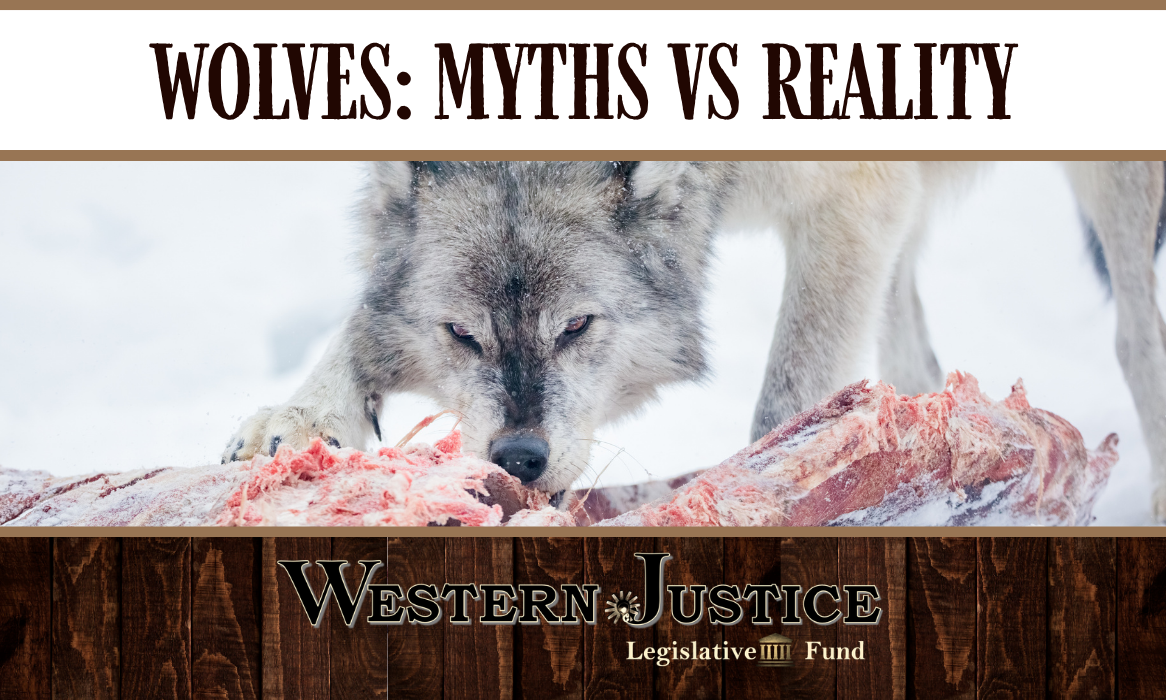
For decades, environmental and animal extremists have pushed a narrative that wolves are benign, beneficial, and even essential to the ecosystem.
These extremist groups, usually with the help of mainstream media, perpetuate several agenda-driven myths: wolves are endangered, wolves restored Yellowstone’s ecosystem, wolves pose no real threat to humans, and wolves help limit the spread of disease. A closer look shows these claims are oversimplified at best, and intentionally propagated with little scientific support.
Myth 1: Wolves Are Endangered
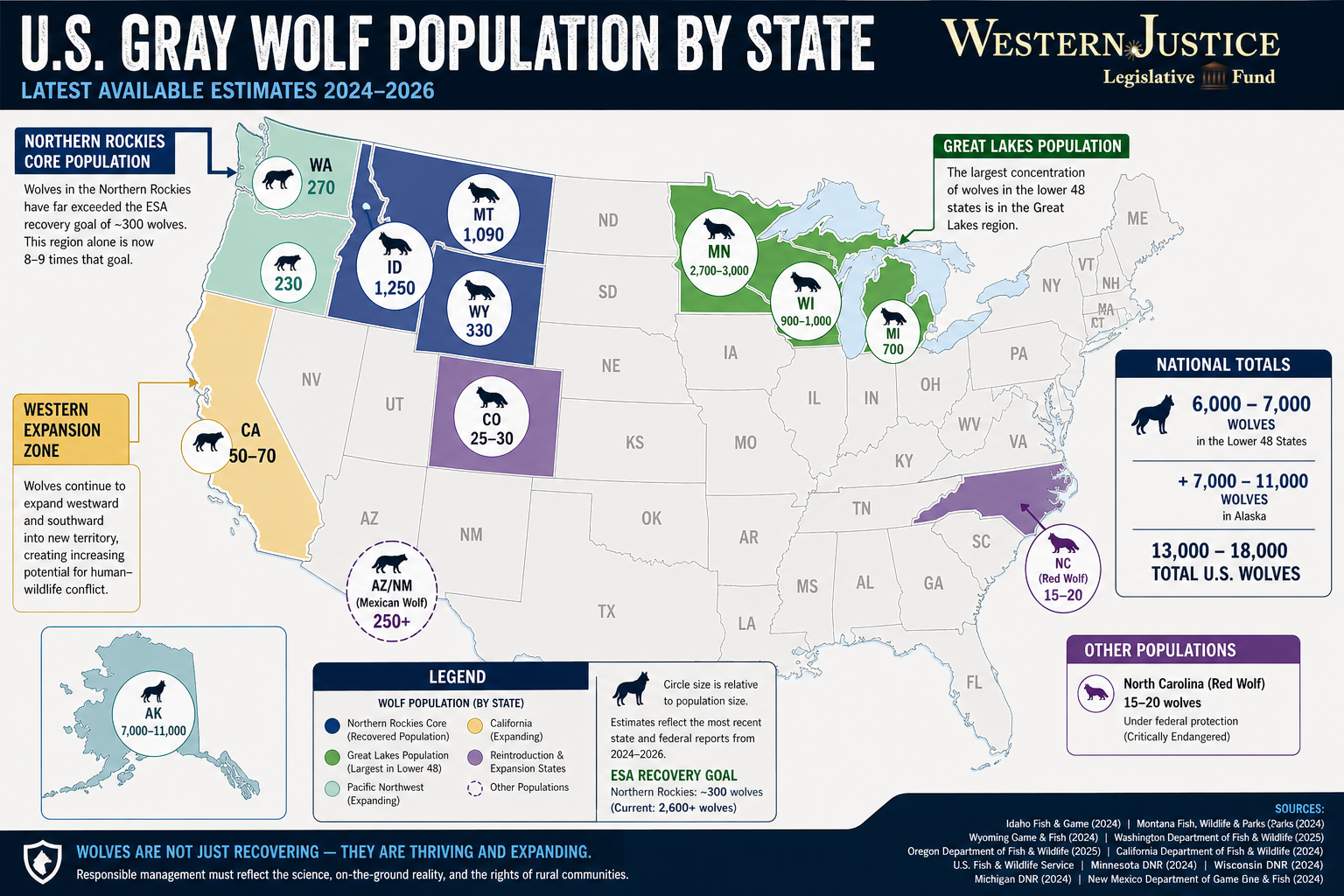
Above all, it is important to realize that the gray wolf has never been endangered on a global scale, or even on the North American continent. Gray wolves have exceeded recovery goals in multiple United States regions, yet remain federally protected across most of the nation due to ongoing litigation—not biological necessity. The legal status of wolves under the Endangered Species Act (ESA) is complicated because it varies by region, subspecies, and ongoing court rulings. Nonetheless, the public is routinely led to believe that wolf populations in general remain fragile, vulnerable, and in need of continued federal protection. The data show the opposite.
Gray wolves have not only met recovery goals — they have exceeded them by a wide margin and continue to expand geographically. In fact, many feel that the official counts drastically underestimate the actual population totals.
Recovery Goals vs. Reality
Federal recovery benchmarks for the Northern Rocky Mountains originally required about 300 wolves, at least 30 breeding pairs, and distribution across Idaho, Montana, and Wyoming. Those thresholds were met over two decades ago, with the Northern Rockies population currently at over 9 times the original ESA recovery target. Wolves have also been introduced or have spread into Washington, Oregon, Colorado, and California.
A species that has surpassed recovery goals, reoccupied vast portions of its historical range, and continues to expand is not endangered—it is managed. Pretending otherwise is not conservation; it is policy driven by agenda-driven ideology rather than evidence.
Myth 2: Yellowstone “Restoration”
One of the most enduring narratives holds that reintroducing wolves to Yellowstone National Park in 1995 “restored” the ecosystem, triggering a dramatic trophic cascade, claiming that wolves reduced elk populations, allowing willows and aspens to rebound, which in turn benefited beavers, songbirds, and other species.
This storyline has been repeated widely — but recent science shows it’s not as clear-cut as often portrayed.
• A 2026 scientific review by Utah State University challenges the headline-grabbing claims that wolves “saved Yellowstone,” that they alone caused a massive resurgence of willow growth that reshaped Yellowstone’s ecosystem. Researchers found that estimates of a 1,500% willow increase were derived from flawed models that essentially predicted results from the same dataset they used to create them. In other words—the desired results shaped the way the data was interpreted. This seriously undermines the strength of the trophic cascade claim.
• Earlier research by Colorado State University scientists concluded that changes in vegetation on Yellowstone’s northern range are not simply the inverse of what happened when wolves were absent. Their 20-year data suggest that grazer dynamics, ecological stability, and multiple predators (not just wolves) shape plant communities.
• Scientists also emphasize that multiple carnivores (grizzly bears, cougars, humans) influence elk populations, and attributing the entire cascade solely to wolves ignores this complexity.
In short, while wolves do affect ecosystem dynamics, the popular claim that their return alone “restored Yellowstone” is a scientific oversimplification propagated far beyond what the actual data can support.
Myth 3: Wolves Are Harmless to People
Another false claim repeated by wolf advocates is that wolves are harmless to humans. This message is used to promote the naïve concept of coexistence. While wolf attacks on humans in recent years are fairly rare, they do happen.
• In April 1996, a biologist, wolf expert, and employee of a Canadian wolf sanctuary, Patricia Wyman, was attacked and killed by the wolves in her care.
• In 2005 in Canada, a 22-year-old man, Kenton Carnegie, was fatally attacked by wolves near Points North Landing, Saskatchewan.
• In March 2010 near Chignik Lake, Alaska, a school teacher, Candice Berner, was killed by wolves as confirmed through DNA analysis of wolves collected near the site. The Alaska State Troopers and Department of Fish and Game concluded that multiple wolves predatorily attacked and killed her while she was jogging alone.
• In July 2018, a U.S. Forest Service researcher conducting salmon research in Washington State was treed by wolves, climbing into a tree to escape them and requiring aerial rescue.
• In 2018, an experienced outdoorsman, Jordan Grider, was camping in northern Minnesota. Authorities found remains the following spring after the snow melt: just 12 bones, including vertebrae, a possible femur and a possible forearm, along with a shredded jacket and other torn bits of clothing, according to the sheriff’s office report. They also reported blood spatter on the walls of a makeshift tent. Later, cadaver dogs found two more bones farther off-site. There was wolf sign at the campsite.
• In April 2025, wolves attacked and killed an elk on a residence’s doorstep in Sierra County, California. While this wasn’t a direct attack on a human, it certainly demonstrates that wolves are fearless and dangerously habituated to humans.
The Sierra County sheriff stated: “Wolves are moving closer and closer into our residential areas and communities… this is becoming a serious public safety concern.”

• In August 2025, also in Sierra County, a man, Gil Clark, was reported missing and presumed to have been “dragged away by wildlife.” Interestingly, in October 2025, it was reported that four wolves from the Beyem Sayo pack in Sierra County had been lethally removed for unprecedented livestock kills. Despite many other livestock kills throughout the state by various wolf packs, the four from the Beyem Sayo pack are, to date, the only four to have been lethally removed. Many suspect they were to blame for the death of Gil Clark.
Myth 4: Wolves Help Control Wildlife Disease
Chronic Wasting Disease (CWD)
One of the most emotionally compelling claims advanced by wolf advocates is that wolves are “nature’s disease control,” selectively removing sick animals and thereby helping curb Chronic Wasting Disease (CWD). The narrative is simple: wolves kill weak deer and elk, so they must slow the spread of disease.
This claim collapses under closer scrutiny — particularly when examining how CWD actually functions biologically.
CWD is not caused by bacteria or a virus. It is caused by misfolded proteins known as prions. These prions accumulate in neural and lymphatic tissues and are extraordinarily resilient. In fact, they can survive freezing temperatures for years, resist degradation under high heat, and persist in soil and vegetation long after an infected animal dies.
This resilience is not speculative — it is well documented in prion science. Once prions enter the environment, they can bind to soil particles and remain infectious, potentially infecting other cervids through grazing.
Here is where the “wolves stop CWD” narrative becomes far more complicated.
Wolves, bears, and cougars are not known to contract CWD in the same way cervids do. However, the fact that predators are not fatally affected does not mean they neutralize prions.
If a wolf kills and consumes a CWD-infected deer or elk:
• It ingests infectious prions.
• Those prions can pass through the digestive tract.
• The wolf then travels miles — sometimes dozens of miles — across the landscape.
• It defecates along travel corridors, rendezvous sites, bedding areas, and grazing grounds.
Because prions are not destroyed by digestion, wolves can redistribute infectious material across the landscape rather than eliminate it. In other words, instead of acting as a disease vacuum, wolves can function as highly mobile dispersal agents — spreading viable prions over larger geographic areas.
While this position is not yet backed by definitive field studies, it highlights a glaring gap in the popular narrative: no long-term empirical field research has conclusively demonstrated that wolf predation reduces CWD prevalence in free-ranging populations.
CWD transmission does not require animals to appear visibly sick. Infected deer and elk can shed prions in saliva, urine, and feces long before showing neurological symptoms. By the time an animal becomes visibly weak, environmental contamination may already be widespread.
Wolf advocates frequently argue that wolves selectively remove the sickest and weakest individuals, thereby serving to almost benevolently improve the overall herd health. But the reality on the ground is much different. Wolves regularly target young and healthy yet vulnerable animals—often leaving them fatally maimed but uneaten, debunking yet another claim of wolf advocates that “wolves only kill what they need to eat.”
The CWD-control argument persists largely because it fits a comforting ecological storyline: that wolves are “natural,” and that wolves regulate herds and therefore regulate disease. But the reality of ecological systems is not that tidy.
Toxoplasma gondii: The Behavioral Wildcard Ignored in Wolf Policy
An often-overlooked factor in modern wolf policy is the role of Toxoplasma gondii (T. gondii)—a globally prevalent parasite with well-documented effects on animal behavior.
Despite extensive research on this parasite, its implications for wolf behavior, public safety, and ecosystem management are largely absent from mainstream policy discussions.
T. gondii is not a rare or emerging issue—it is endemic across much of the globe. Studies have documented widespread infection rates in wildlife populations for decades. In Northern California, for example, research dating back to the 1970s found that 30–70% of tested carnivores were already infected, indicating long-standing environmental presence.
The parasite’s lifecycle is anchored in felids (cats, including mountain lions), which serve as primary hosts. These animals shed infectious oocysts in their feces, contaminating soil, water sources, and vegetation. These oocysts are remarkably durable, capable of persisting in the environment and becoming infectious shortly after deposition. Transmission occurs through direct contact with contaminated soil or feces, consumption of infected prey, and inhalation or ingestion of contaminated particles.
This creates a pervasive environmental exposure risk for a wide range of species, including wolves.
T. gondii is not a passive infection. It is a neurotropic parasite that forms cysts in brain tissue and alters host behavior in ways that enhance its transmission. Scientific studies have demonstrated that chronic infection can increase dopamine and testosterone levels, reduce fear responses and risk aversion, increase aggression and exploratory behavior, and decrease avoidance of predators and novel stimuli.
In practical terms, this can manifest as reduced wariness of humans, increased movement and territorial expansion, and higher likelihood of approaching unfamiliar or dangerous environments. This could explain incidents like the Sierra County, California wolf kill on a home’s doorstep.
Moreover, research suggests that infected wolves may exhibit increased dispersal tendencies and leadership behaviors, potentially influencing pack structure and behavior over time.
This raises a critical concern: if infected individuals are more likely to take risks, expand territory, and assume leadership roles, they may shape pack behavior in ways that amplify conflict, even among otherwise uninfected wolves. In this context, behavioral changes are not merely individual—they can become cultural within packs, spreading learned behaviors that increase dangerous conflict with livestock, human infrastructure, and developed areas.
Wolves can also contribute indirectly to the spread of T. gondii across landscapes. By moving extensively across territories and interacting with multiple prey species and habitats, wolves can increase overlap between infected and uninfected wildlife populations, facilitate transmission through predation and scavenging pathways, expand the geographic footprint of exposure risk
T. gondii is not confined to wildlife. It has been documented in livestock, where it can affect reproduction and herd health; in domestic animals, particularly cats and dogs; in humans, where infection has been associated with neurological and behavioral effects.
This makes it not just a wildlife issue, but a broader ecological and public health concern.
And yet, despite decades of research on T. gondii, its potential role in shaping predator behavior is rarely considered in wolf management discussions.
Conclusion
What is at stake is not simply how we view wolves, but whether wildlife policy in the United States will be guided by evidence or by narrative. When agendas replace science, the consequences are not abstract—they are borne by rural families, livestock producers, wildlife populations, and the integrity of conservation itself. Wolves are not symbols, moral actors, or ecological cure-alls; they are apex predators whose impacts must be managed with clear-eyed realism. Continuing to base policy on myth, selective science, and emotional appeal undermines both public trust and effective stewardship. If policymakers are serious about conservation, they must reject ideology-driven management and return to a foundation rooted in data, accountability, and respect for the people and ecosystems most directly affected. Anything less is not conservation—it is fiction with dire real-world consequences.


