
Recommendations for Economic and Ecological Restoration of Western Rangelands
In recent decades, the USFS and BLM have cut permitted livestock on some western rangelands up to 80%, and in some cases 100%, in their politically fueled effort to remove all livestock from federally managed lands. These economic attacks on the rural west were compounded by the governments’ listing of the spotted owl which effectively destroyed the western timber industry.
Economic mayhem was accomplished by the BLM and USFS, and other federal agencies by bombarding timber companies and ranchers with derogatory administrative decisions while simultaneously partnering with environmental NGO’s in “sue and settle” lawsuits to achieve much of their lock-it-up policy through the courts. A recent DOI Inspector General Report found that during the Obama Administration settlements with environmental non-profits averaged $800 million per year in what has all of the appearances of a government orchestrated money laundering scheme.
The cumulative result of 50 years of BLM and USFS “lock it up” policies is that the very lands these agencies are charged with protecting have unfortunately deteriorated into environmental decay. Most notably they are chronically ravaged with wildfires, with some areas being burned over multiple times. While fires have always occurred on vacant federal lands, it was unheard of to have those fires rage for months at a time, much less burn down entire towns and neighborhoods.
Meanwhile many ranchers have been drug into endless costly administrative appeals and decades-long federal court cases to defend their livelihood against false allegations such as overgrazing and riparian damage and prevent their ranches from being seized by administrative fiat. Other ranchers watching these high-profile cases from the sidelines, are legitimately fearful of being drug into court, and have compromised with the agencies to the point their ranches are no longer economically viable. Today, many ranches are no longer economic units as envisioned under the Taylor Grazing Act and ranchers are loading their livestock onto stock trucks twice a year to find summer and/or winter pasture. In doing so, they are driving past their own range allotments which are often riddled with dead forage waiting for the next fire.
Following are recommendations to help restore ecological health and economic viability to the rural west:
• Restore permitted livestock numbers and seasons of use to original grazing preference levels established by USFS and BLM during their original range adjudication, records of which are part of the official record of the agency.
• Reinstate cancelled grazing preferences on “vacant” allotments and issue grazing permits to the ranches to which those allotments are appurtenant, or their successors in interest.
• Create a categorical exclusion under NEPA from environmental assessments for term grazing permit renewals for grazing preference holders. The reissuance of an existing term grazing permit does not meet the definition of a new major federal action. Government sanctioned livestock grazing has occurred on western federal lands since the mid 19th century. The vested stockwater and irrigation water rights and rights of ways belonging to ranchers were acknowledged and protected by Congress in the 1866 Mining Act, the Forest reserve Act of 1891, the 1934 Taylor Grazing Act and 1976 Federal Land Policy and Management Act. Most of these waters arise on federally managed lands and were the basis by which the USFS and BLM adjudicated grazing allotments to issue grazing preferences and permits to historical ranches in the first place. Preexisting valid rights of ranchers were recognized and incorporated by the USFS and BLM into government issued grazing preferences and term grazing permits well before the passage of NEPA. Therefore, permitted livestock grazing is not a new major federal action.
• Where conflicts exist as a result of the government allowing wild horse numbers to exceed Herd Management Levels as set by the Wild Horse and Burro Act, remove wild horses or compensate ranchers for lost forage (AUM’s) and water consumed by horses.
• Where horses exist outside Herd Management Areas as established by the Wild Horse and Burro Act, remove horses in accordance with the law.
• Audit the Range Improvement Fund to determine the amount of monies diverted from the fund for other purposes. Restore funds and disburse as the law mandates.
Historical Snapshot and Legal Foundation:
In 1836 the first wagon train of pioneers ventured out from St. Louis, Missouri on what is now known as the Oregon trail. The United States was anxious to solidify its’ territorial claims to the Oregon Territory. It was only the federal government’s ability to lure its own citizens to put all their worldly belongings into a wagon, risk their lives and venture into the untamed West with the promise of cheap land that prevented the distant governments of Great Britain, Spain and Russia from establishing permanent colonies on America’s west coast.
The present southwestern states were ceded to the United States under the terms of the 1848 Treaty of Guadalupe Hidalgo following the defeat of Mexico in the Mexican–American War. The discovery of gold in 1849 at Sutter’s Mill, California set off a rush of the ‘49ers looking to make their fortune in mining. Ten years later, the Comstock Lode in Nevada as well as numerous other smaller silver and gold deposits across the West enticed more pioneers who ensured the United States’ governance on lands from the Atlantic to the Pacific Ocean.
Miners sought their fortune by claiming small tracts of lands where silver and gold could be found in concentrated quantities. Businesses of all types sprung up on the main streets of every mining camp and town in the West. The limited arable ground suitable for cultivation was quickly homesteaded for farming and pasture. Rangeland ranches were quickly established.
In the mid-19th century, most of the remaining non-arable western public domain was designated by the United States as chiefly suitable for livestock grazing. These were lands often receiving less than 10 inches of rainfall per year. Congress also passed a series of laws encouraging Western settlement including ranching. Chief among them was the Act of July 26, 1866. It acknowledged and protected vested water rights and the construction of privately-owned ditches, pipelines and roads across the public domain. Specifically, the Act stated,
“That whenever, by priority of possession, rights to the use of water for mining, agriculture (including livestock raising), manufacturing, or other purposes, have vested and accrued, and the same are recognized and acknowledged by the local customs, laws, and the decisions of the courts, the possessors and owners of such vested rights shall be maintained and protected in the same.” 262 US 253
Stockmen who trailed cattle and sheep into West were often the first to appropriate stockwater under the western prior appropriation water law. Under local laws, customs and court decisions of the time the surrounding rangelands were also claimed for the non-exclusive and limited purpose of livestock grazing. The same land that was claimed for livestock grazing was also accessible to the public for hunting, recreation, mining and transportation, but under local custom the range was used exclusively as against other ranchers by those who first appropriated the water.
By the 1870’s virtually all of the non-arable public domain had been settled and appropriated by livestock foragers. Rangeland ranches, unique to the West, often described as “outfits”, included a mix of irrigated patented land, and stock water on the public domain, with the surrounding rangelands serviced by the stock waters. Ranchers built ditches, pipelines, windmills, and stock tanks to spread water and evenly scatter livestock, or nature’s lawnmowers, over the range. They built crude roads, maintained stock trails, built camps and a host of other range improvements. These ranches were bought, sold, or conveyed by will. Banks issued mortgages which included the range, water rights, and improvements as collateral. A body of law, local customs and court decisions recognized rancher’s various property interests in the rangelands. The courts protected those interests until recent decades when the industry was overwhelmed by a bloated federal administrative state weaponized by its arsenal of agenda-driven DOJ attorneys.
The Forest Reserve Act of 1891 gave the President power to set aside Forest Reserves, with the Constitutional protections that it “shall not affect any valid rights heretofore accrued...” In 1897 what is commonly known as the Organic Administration Act of the USFS, a rider to an appropriations bill, Congress stated forest reserves were established for two purposes only—timber preservation and enhancement of water supply. However, the water and rangelands within the newly established forests reserves had long been appropriated for irrigation and stockwater use for local ranches and farms.
Congress has deliberately and consistently protected preexisting vested rights in its land laws.
In 1905, the Forest Service was created wherein they were charged with conducting extensive range studies to determine the numbers of livestock the forests could support, and which ranchers had preexisting customary rights to the range and stockwaters. They then surveyed the range into official grazing allotments and issued grazing permits to those ranchers who qualified by proving customary use and ownership of water rights. An administrative grazing fee was assessed for the USFS to manage the grazing program. Permits could not be issued to newcomers unless the rangeland in question was previously unclaimed. The U.S. Supreme Court in a trilogy of cases in 1912, in one case upheld the preexisting rights of a rancher in the newly created Yosemite National Park and twice denied the right of newcomers to graze without a grazing permit.
A similar scenario occurred under the 1934 Taylor Grazing Act on all lands now administered by the BLM:
“That in order to promote the highest use of the public lands pending its final disposal, the Secretary of Interior is authorized…to establish grazing districts…[on] an area of eighty million acres of vacant, unappropriated, and reserved lands…which in his opinion are chiefly valuable for grazing and raising forage crops…Nothing in this Act shall be construed in any way to diminish, restrict, or impair any right which has been heretofore or maybe be hereafter initiated under existing law validly affecting the public lands….nor as limiting or restricting the power or authority of any State as to matters within its jurisdiction.” 865 U.S. § 1269.
Notably the Act carefully protected vested water rights:
“That nothing in this Act shall be construed or administered in any way to diminish or impair any right to the possession and use of water for mining, agriculture, manufacturing, or other purposes which has heretofore vested or accrued under existing law validly affecting the public lands or which may be hereafter initiated or acquired and maintained in accordance with such law.”
Contrary to the actions of the BLM in recent decades, Congress intended grazing privileges to be protected, not diminished or eliminated.
“So far as consistent with the purposes and provisions of this Act, grazing privileges recognized and acknowledged shall be adequately safeguarded, but the creation of a grazing district or the issuance of a permit pursuant to the provisions of this Act shall not create any [new] right, title, interest, or estate in or to the lands.” 865 U.S. § 1271
By the time the BLM surveyed rangelands claimed and historically grazed by existing ranches, most of those ranches had been in operation for nearly 100 years. Like the USFS, the BLM underwent an extensive range adjudication to scientifically determine the carrying capacity of the range and carefully quantify seasons of use, numbers of different classes of livestock and wildlife, appurtenant private pasture, water rights and range improvements. Government surveyors conducted official surveys of allotment boundaries. Grazing preferences were recognized and permits issued to those ranchers with preexisting rights. Had Congress determined to issue grazing permits to newcomers as opposed to those ranchers with preexisting vested rights servicing adjoining rangelands, the government would have been subject to enormous claims for Constitutional takings of private property interests under the Fifth Amendment.
The Omnibus Federal Land Policy and Management Act of 1976 further clarified the intent of Congress to protect preexisting vested rights or uses previously authorized under federal law in Section 701: “Nothing in the Act, or in any amendment made by this Act, shall be construed as terminating any valid lease, permit, patent, right-of-way, or other land use right or authorization existing on the date of approval of this Act.” Subsection (g) states, “Nothing in this Act shall be construed as limiting or restricting the power and authority of the United States or, (6) as a limitation upon any State criminal statute or upon the police power of the respective States, or as derogating the authority of a local police officer in the performance of his duties, or as depriving any State or political subdivision thereof of any right it may have to exercise civil and criminal jurisdiction on the national resource lands…:” and Subsection (h) states, “All actions by the Secretary concerned under this Act shall be subject to valid existing rights.”
Beginning in the 1970’s radical forces within the agencies sought to eradicate the western rangeland ranching industry. In most cases they elected to boil the frog slowly, and gradually cut livestock numbers or seasons of use with a myriad of administrative decisions. They further invited sue and settle lawsuits from environmental non-profits with a preordained “settlement” accomplishing their policy through the courts. In other cases, the BLM and USFS threw the full force and weight of the federal government behind efforts to target and drive ranchers out of business such as in the Hammond, Hage, Goss, Martinez, Yowell, Dann, Colvin, Korman and Bundy cases, just to name a few. The cumulative cuts to permitted livestock numbers in Nevada are over 80 percent, decimating a once thriving industry while leaving lands covered with dead forage ripe for unprecedented and recurring catastrophic range fires. Similar cuts have occurred in all twelve western states on lands administered by the USFS and BLM.
Those who have sought remedy in the Courts or sought compensation from the government for the taking of Constitutionally protected property interests have seen the Department of Justice use every method of deceit and fraud available to prevent any precedent for compensation. The Hammonds were maliciously prosecuted as domestic terrorists for backfires that accidentally burned a small amount of adjacent vacant federal land. They were thrown in jail, and ultimately pardoned by President Trump, in what was widely recognized as an unethical and malicious prosecution. The Bundys had their criminal trials for their infamous 2014 standoff with the BLM dismissed with prejudice because of gross DOJ, BLM and FBI prosecutorial misconduct and their withholding of exculpatory evidence.
The Hage family probably suffers the distinction of having the most litigated case involving western rangeland ranching and water rights, but more importantly their numerous published decisions upholding their Constitutionally protected property interests, are what is important in the context of the recommendations outlined above.
The family has spent 41 years and two generations in the courts in three administrative appeals, a state water adjudication, and two lengthy federal trials in two federal courts to defend their Constitutionally protected property rights from a government taking. They received multiple extraordinary published rulings in their favor in each jurisdiction against the government. After two separate trials lasting seven weeks in the U.S. Court of Federal Claims the Hags were awarded a $14 million judgment against the government for a Constitutional taking of property under the Fifth Amendment.
In a separate federal case, after a month-long trial in Nevada Federal District Court the court made nearly identical findings as the Claims Court regarding the government’s conduct, but also found the federal government engaged in a conspiracy to take grazing preferences and vested water rights, engaged in conduct “shocking to the conscience of the court” and referred several employees for criminal prosecution.
The Federal Circuit Court of Appeals on appeal from the Claims Court overturned the $14 million judgment and findings of the trial court judge who sat through the hearings, heard testimony of multiple witnesses and reviewed thousands of pages of evidence. Instead the Appeals Court substituted their own findings contrary to the facts, rules of procedure and court precedent. The Ninth Circuit Court of Appeals in the second case, on appeal from the Federal District Court of Nevada circumvented the findings of Judge Jones by ruling he was biased, removed him from the case, and ruled entirely in favor of the USFS and BLM and remanded the case to a new District Judge, District Judge, Gloria Navarro, who proceeded to add $400,000 in trespass charges against Wayne Hage, Jr. The Congressional rate to graze cattle on federal land is $1.35 per cow per month. The Supreme Court denied certiorari.
The efforts by forces within and outside of government to eliminate the western rangeland ranching industry has consequences that are not widely recognized outside of the rural west. The first is fires. As mentioned above permitted livestock have been dramatically cut and fuel loads have accumulated creating conditions ripe for range and forest fires. Where fires have been rampant, invasive species of highly inflammable cheat grass have replaced native shrubs and grasses, exacerbating the fire danger.
Second, as ranchers have been driven out of business and off the range, all of the water developments they built and maintained, including the pumping of wells, have been let go and shut down, also impacting wildlife and horses.
Third, what is not widely understood by policy makers is the water rights and other Constitutionally protected property interests’ ranchers and their successors-in-interest own on federally administered lands are not eliminated when a grazing permit is cancelled. Consequently, as the Ninth Circuit has ruled in two case, U.S. v. Hage and U.S. v. Hunter, when the government refuses to issue a grazing permit to the owners of vested water rights on federal lands, then those ranchers have the right to remove that water via an 1866 Mining Act right-of-way, which is not subject to the permitting requirements of the Federal Land Policy and Management Act of 1976.
The western range rancher has been successfully targeted, smeared and demonized by radical forces within the agencies and DOJ and by the environmental left. Epitaphs of “welfare ranchers,” and “cattle free by ‘93” have littered publications from Earth First to the Wall Street Journal. The main charge leveled against ranchers, without evidence, is that they overgraze. Yet most federal employees and environmentalists mow their lawns. Livestock are nature’s natural lawnmowers and ranchers have every incentive to rightly steward the land and develop and maintain the limited water for their own self-interests and long-term survival. Overgrazing is economic suicide for ranchers, both destroying feed for the next year but also jeopardizing weight gain and health of animals that are marketed by the pound. In addition, throughout the history of the American west, wildlife numbers have been at their highest when livestock numbers were also at their highest. In the journals of the first explorers into Nevada, deer and elk were non-existent, and big horn sheep limited. In fact, many early explorers in Nevada were forced to slaughter their horses and mules, or worse dogs, to survive the journey across the territory.
Many of us have lived through the shuttering of rural towns and suffered months of choking smoke as rangelands and forests are repeatedly burned by catastrophic fires. In recent years we have watched entire towns and neighborhoods burn and most tragically people incinerated in an inferno they could not escape. We have seen families destroyed, old ranchers hauled off in leg-chains, or even assassinated in lieu of arrest, only to turn around and see the very lands the government is purportedly protecting, locked-up, infested with noxious plants and tree-destroying beetles, or overgrazed by unmanaged horses. To add insult to injury millions of gallons of water are flushed down the delta of California every year purportedly to protect a one-inch fish. The insanity of these federal policies are tragic to watch especially when they are completely preventable and unnecessary.
The recommendations above go far to help restore the heath of the western rangelands, diminish fuel loads, and begin to restore rural economies. As economists note, all wealth comes from the land, or the sea. When the land is locked-up from productive use and wise stewardship it becomes the proverbial untended garden. The reforms necessary to fix the dysfunctional and all-powerful administrative state are beyond the scope of this paper. The reforms recommended above however will at least, in part, remove the administrative shackles off the Western rancher who out of necessity and heritage is the natural, on-the-ground steward of the America’s rangelands.
Authored by: Ramona Hage Morrison, consultant and court certified expert witness on federal lands policy, western ranching history and practices, vested water rights and historical ranch property title.
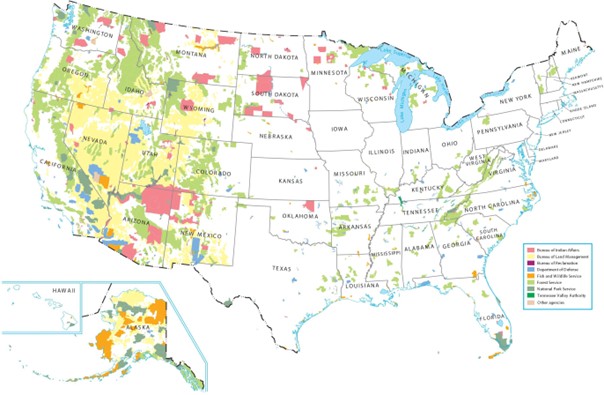
ONE THIRD THE NATION’S LAND
QUICK FACTS
BLM
831 ADJUDICATED GRAZING ALLOTMENTS
2,153,780 AUMS - PERMITTED
566,185 AUMS - SUSPENDED
17,860 AUMS – SUSPENDED TEMPORARY
50,531,954 ACRES
USFS
327 ADJUDICATED GRAZING ALLOTMENTS
223 ALLOTMENTS WITH PERMITTED AUMS
104 INACTIVE/NON-USE ALLOTMENTS
291,936 PERMITTED AUMS
CURRENT AND PAST LIVESTOCK NUMBERS ON SEVERAL NEVADA OPEN RANGE RANCHES BASED ON RESEARCH OF AUTHOR OF HISTORICAL RANCH TITLE
Ranch #1:
Prior to 1905 -- 3,758 cattle; 20,000 sheep; 567 horses
Current permitted livestock – USFS 603 cattle, summer; BLM 8,128 AUMs, 812 cattle winter
Ranch #2:
Prior to 1905 – 1,872 cattle; 16,722 sheep, 34 horses Current permitted livestock – 0 livestock
Ranch #3:
Prior to 1905 – 120,000 sheep, winter
Current permitted livestock – 3,100 cattle, winter


