King Ranch Case: Agricultural Lawfare, Institutional Control, and the Constitution
The King Ranch case is no longer simply a dispute over stock ponds. It has become a revealing case study in how administrative enforcement, executive appointment power, and regulatory expansion can converge into a single pressure point against a private ranching family.
At the center of the fight are Wade and Teresa King — multi-generational ranchers in central Washington — who now face a $267,000 fine, potential $3.7 million in demands for restoration of alleged wetlands, secretive criminal investigation, ongoing administrative prosecution, and a judicial assignment that raises structural impartiality concerns.
Individually, each development might be explained away. Collectively, they paint a picture of institutional consolidation that should concern anyone who values constitutional limits.
And now, the federal government has given this pattern a name: agricultural lawfare.
The Federal Recognition of “Agricultural Lawfare”
On February 11, 2026, the U.S. Department of Agriculture announced its Farmer and Rancher Freedom Framework to End Agricultural Lawfare. The press release warned that farmers and ranchers across the country are increasingly being subjected to coordinated legal and regulatory pressure campaigns designed not merely to ensure compliance — but to burden, intimidate, and economically exhaust agricultural producers.
USDA described lawfare as the strategic use of regulatory enforcement, litigation, and administrative processes to impose punitive costs, expand agency authority beyond clear statutory boundaries, and coerce operational change without legislative approval.
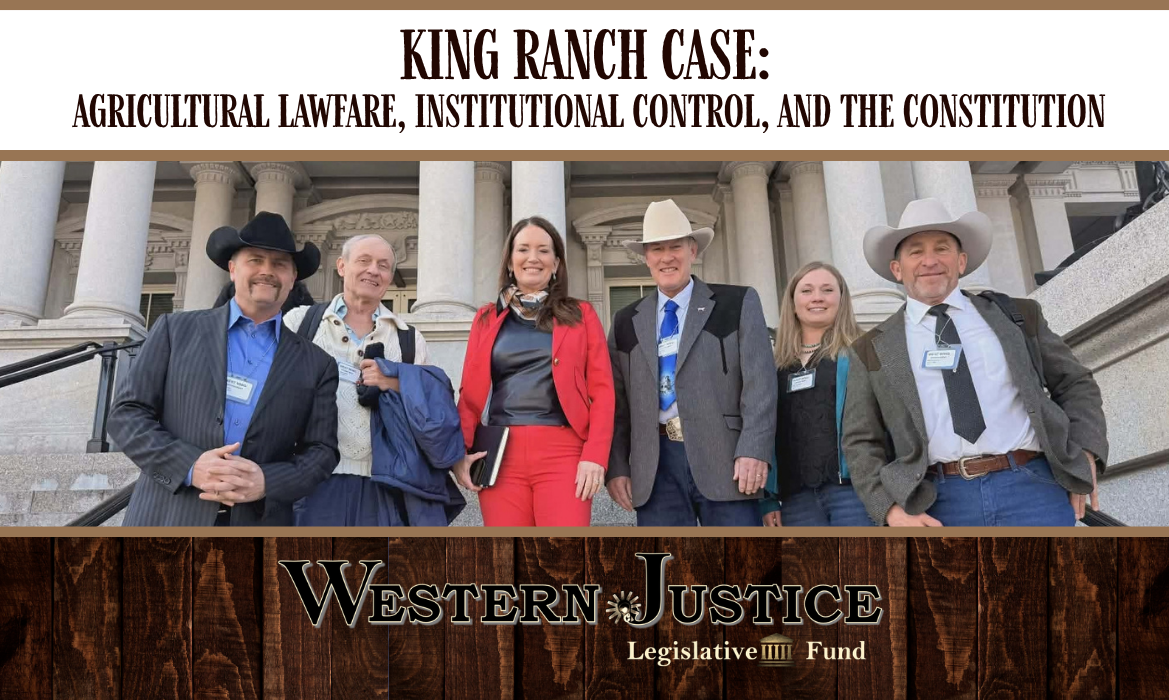
The King Ranch case fits that description with striking precision; in fact, Wade and Teresa King were in Washington DC for the inaugural meeting, along with the Maudes from South Dakota.
Enforcement Begins — Before the Investigation Ends
The Washington Department of Ecology (DOE) issued a $267,000 penalty against the Kings and ordered sweeping “restoration” of 32 alleged water bodies.
Yet the agency has not personally inspected most of those sites.
Instead, enforcement orders were issued first — followed by attempts to compel access to private property afterward. The Kings were effectively declared liable before the state completed full on-site investigations.
As King family attorney Toni Meacham put it, “It’s like mailing someone a DUI citation and then later trying to determine whether they were actually driving under the influence.”
Experts estimate that the demanded restoration could cost at least $3.7 million. This is not minor regulatory compliance. It is economically existential pressure.
Under the USDA’s framework, this type of front-loaded punitive enforcement — where penalties and restoration costs precede full factual development — is one of the hallmarks of lawfare. The process itself becomes the punishment.
Institutional Proximity and Judicial Assignment
As the constitutional and statutory fight escalated, the case was reassigned shortly before a scheduled hearing.
The newly assigned judge previously served more than twelve years in the Washington Attorney General’s Office — including four years as a Managing Assistant Attorney General. That same office continues to represent the Department of Ecology in this litigation.
The Kings have filed a motion for recusal under Washington Code of Judicial Conduct Rule 2.11, which requires disqualification where impartiality “might reasonably be questioned.”
They are not alleging corruption.
They are raising a structural concern:
• The Department of Ecology brings enforcement.
• The Attorney General’s Office prosecutes the case.
• The Governor appoints the judge.
• The appointed judge recently held senior supervisory authority within the very office litigating against the Kings.
Individually, each role is lawful. Together, they narrow institutional distance.
Judicial legitimacy depends not only on actual fairness — but on visible separation between prosecutor and adjudicator. When enforcement, representation, and appointment all flow through closely connected executive channels, public confidence can erode.
That is why Rule 2.11 exists.
Administrative Prosecution Without a Jury
The case is currently before the Pollution Control Hearings Board (PCHB), an executive branch administrative tribunal.
Under both the Seventh Amendment and Washington Constitution Article I, Section 21, citizens are guaranteed a jury trial when punitive fines are imposed. In 2024, the U.S. Supreme Court reaffirmed in SEC v. Jarkesy that agencies cannot sidestep juries when seeking civil penalties.
Yet the PCHB has no mechanism to seat a jury, lacks authority to decide constitutional jury claims, and has allowed enforcement to continue without resolving the Kings’ jury demand.
If the Kings proceed fully through the PCHB without relief, they risk permanently losing their constitutional right to a jury trial.
USDA’s framework warns that administrative tribunals can be used to bypass traditional judicial safeguards, concentrating prosecutorial and adjudicative power within the executive branch.
Statutory Protections Being Ignored
The core of the dispute involves stock water rights. Under RCW 90.44.050, stock watering is permit-exempt. When the groundwater code was enacted in 1945, lawmakers deliberately protected water essential to life — both human and animal.
The Kings compiled a 1,157-page evidentiary declaration documenting historic stock water use dating back to settlement.
RCW 90.48.422(3) prohibits Ecology from enforcing water pollution statutes in a way that abrogates, supersedes, impairs, or conditions a permit-exempt water right.
Yet the arbitrary, egregious enforcement continues.
USDA’s framework cautions that lawfare often manifests when agencies stretch statutory authority beyond legislative intent — especially where longstanding agricultural exemptions exist.
Rulemaking During Litigation
After the Kings pointed out that Ecology claimed permits were required despite no clear permitting pathway existing, the agency initiated rulemaking for a new State Water Alteration Permit (SWAP). Draft language indicates agricultural exemptions may be narrowed or removed.
USDA’s lawfare framework specifically warns against regulatory moving goalposts, where agencies pursue penalties under unclear rules and then revise regulations midstream to solidify authority.
Water Control Is Land Control
When ranchers face six-figure penalties, multi-million-dollar restoration demands, administrative tribunals without juries, expanding rulemaking, and executive proximity in judicial oversight, the pressure is cumulative.
In arid Western states, water is viability. If permit-exempt stock water rights can be retroactively regulated into extinction, ranching becomes conditional — not secure property ownership.
What began as a dispute over stockwater ponds now fits squarely within a broader national debate recognized by USDA: whether regulatory systems are being used as neutral enforcement mechanisms — or as instruments of agricultural lawfare.
For King Ranch, this is about survival.
For Washington, it is about whether executive authority remains bounded.
For rural America, it is about whether law protects property — or regulates it out of existence.
Read more HERE.


