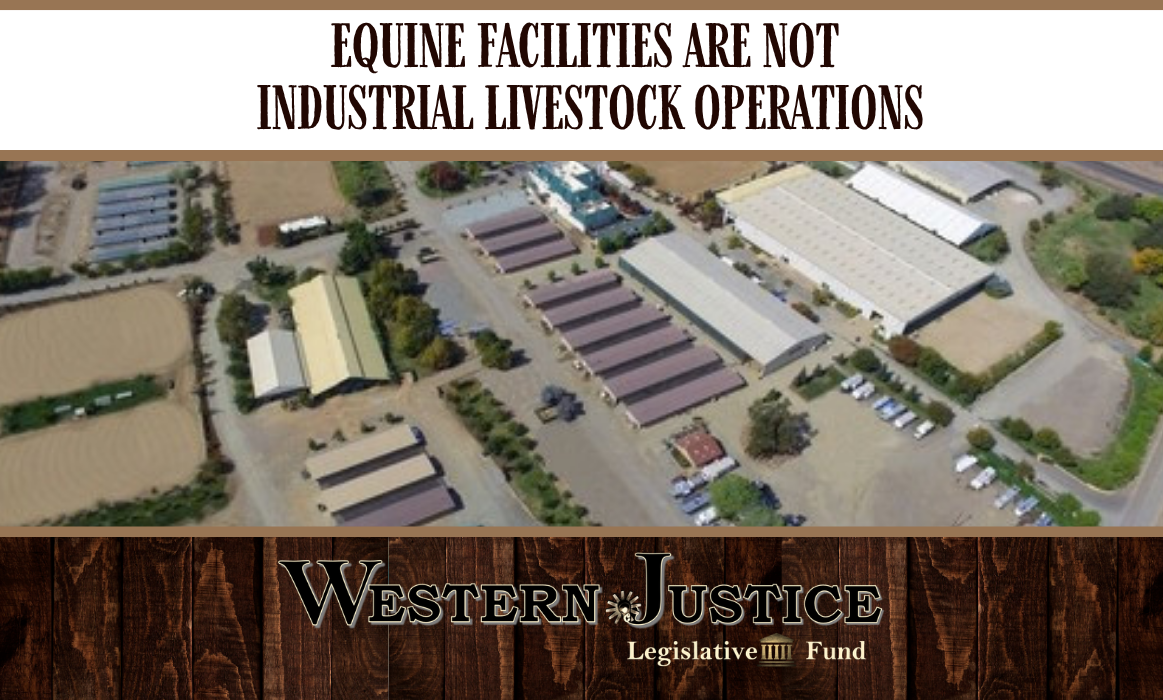
Equine Facilities Are Not Industrial Livestock Operations
There’s no question that America has a long history with horses, both as working partners and as the core component of vibrant and diverse recreational and professional communities.
Yet federal rules treat equine venues like large-scale livestock production facilities under Concentrated Animal Feeding Operation (CAFO) regulations, opening a dangerous door for environmental and animal extremist activism. A stark recent example underscores the threat: in November 2024, a federal court in California granted summary judgment to the California Coastkeeper Alliance in a Clean Water Act lawsuit brought against Murieta Equestrian Center, a prominent horse show and training facility operated by Cosumnes Corp. and owned by the Carol Anderson Ward Trust, ruling that the prominent horse show and boarding facility qualified as a CAFO and violated the Clean Water Act by discharging pollutants without an NPDES permit.
This case illustrates why Congress and/or the EPA must reform CAFO rules and exempt equine event facilities. Misapplying industrial livestock production standards imposes undue burdens on recreational and competitive horse venues and hands powerful tools to NGOs and other entities seeking to shutter them.
Nutrition, Waste, and Management: Fundamentally Different
A core mismatch lies in animal nutrition and its direct impact on waste. Horses are fed primarily forage-based diets—hay, pasture, and performance supplements with moderate grain—to support athletic demands, digestion, and long-term health. As hindgut fermenters, they produce solid, fibrous manure that is relatively dry, significantly lower in liquid volume, and easier to manage, compost, stockpile, or haul away. This manure has balanced nutrient profiles (roughly 0.7% nitrogen, 0.3% phosphorus, 0.6% potassium) and breaks down readily with bedding, posing a lower risk of concentrated nutrient runoff when handled with standard best practices.
In contrast, traditional livestock facilities often receive high-energy, grain-heavy rations optimized for rapid growth and production. These diets generate more liquid manure with higher concentrations of certain nutrients and volatile compounds. Large-scale livestock operations produce vast quantities of waste—often stored in lagoons. The same stringent regulatory oversight applies to storm-water runoff from these operations.
Conversely, equine facilities, with their transient horse populations, fundamentally different manure composition, and solid-waste handling practices do not create the same environmental profile as large modern livestock facilities. Applying one-size-fits-all CAFO rules to horse show facilities ignores these biological and operational realities.
Distinct Purposes Demand Distinct Rules
CAFO rules under the Clean Water Act target operations confining substantial numbers of animals (500+ horses for large CAFO status and 150-499 horses for medium CAFO status) for 45+ days per year in non-vegetated areas. EPA promulgated its CAFO regulations primarily to curb far greater volumes of manure discharges from food-production systems. Traditional CAFOs focus on efficiency in meat, poultry, milk, or egg output, often with a relatively steady animal inventory generating concentrated liquid waste.
Horse facilities differ fundamentally. They host transient horses owned by third parties for breeding, competitions, training, clinics, and exhibitions. Facilities like Murieta Equestrian Center invest in arenas, spectator amenities, and bring business to surrounding areas. Yet the Coastkeeper ruling illustrates how stormwater from arenas and grounds during events can trigger CAFO liability—turning a show venue into a de facto industrial agriculture operation overnight.
The Murieta Case: A Cautionary Tale
The California Coastkeeper Alliance’s multi-year lawsuit against Murieta Equestrian Center highlights the real-world stakes. The group alleged unpermitted discharges into nearby waters, ultimately securing a ruling that the facility met the criteria for a medium CAFO due to its capacity and operations. While environmental compliance matters, this victory equips activists with precedent to target other venues through citizen suits. What begins as a water-quality dispute can escalate into existential threats for operators facing injunctions, penalties, and endless litigation from well-funded NGOs
Animal Extremist Agenda: A Clear and Present Danger
We must speak plainly about the broader risk. The animal extremist movement has long opposed horse ownership, breeding, showing, racing, and even recreational riding, viewing them as exploitative. Designating equine facilities as CAFOs hands extremist groups a potent legal weapon. Groups like Coastkeeper can file citizen suits under the Clean Water Act, seeking shutdowns, costly retrofits, or operational halts via injunctions. A CAFO label invites relentless scrutiny, permit battles, and public campaigns that portray horse venues as intensive livestock operations.
This is not speculation. Environmental litigation often aligns with animal extremist goals of eliminating animal use. If unchecked, CAFO status could become a backdoor strategy to dismantle the horse industry—driving up costs until smaller venues close, events dwindle, and vibrant horse-centered traditions fade. The Murieta precedent risks a chilling effect across California and nationally, where activists can more easily target equine facilities.
Economic and Cultural Stakes
The U.S. horse industry generates over $177 billion annually and supports millions of jobs. Unnecessary over-regulation threatens rural economies, tourism, youth programs, and open-space preservation. Imposing production-oriented rules on equine facilities diverts resources from genuine pollution sources while punishing stewards who already follow best management practices.
Targeted Reform
A sensible fix is straightforward. Legislation and/or revised EPA regulations and guidance should exempt equine facilities whose primary purpose is competition, training, exhibition, recreation, breeding, and/or boarding. EPA should limit CAFO status for horses to permanent, feedlot-style operations holding slaughter-bound animals—aligning regulation with the Congressional intent of curbing pollution, while respecting the biological differences in nutrition and waste.
The Murieta ruling should serve as a wake-up call, not a blueprint. Policymakers must carve out equine facilities before activist lawsuits multiply. America’s arenas, tracks, and trails enrich lives and communities. Our long-standing horsemanship heritage deserves better than a regulatory straitjacket designed for large-scale food production animals.


